
ENERGY ANALYST Position: Career Path to Energy Manager

Grow from analyzing building performance to helping lead it.

Energy@Work is looking for an Energy Analyst who is ready to take the next step in their career and contribute to our growing team.

This opportunity is intended for an analyst who has a solid foundation in energy analysis and building performance and is ready to develop stronger client-facing skills, broaden their technical experience, and build toward the role of Energy Manager.

At Energy@Work, our analysts do more than work with utility data. They become involved in understanding how buildings operate, identifying opportunities, connecting with building operators and property management teams, measuring results, and helping clients turn energy information into action.

You will work alongside a seasoned team of energy managers, engineers, analysts, sustainability professionals and Measurement & Verification practitioners who will support your professional development.

What You Will Work On

·  Energy and utility data analysis for commercial, institutional and multi-residential buildings;

·  Energy performance benchmarking and normalization;

·  Measurement & Verification (M&V) of energy savings;

·  RETScreen Expert modelling and analysis;

·  Energy Conservation Measure and Energy Efficiency Measure analysis;

·  Monitoring & Targeting and ongoing building performance reviews;

·  Existing Building Commissioning and operational optimization projects;

·  Reviewing BAS trends and helping identify operational energy opportunities;

·  ENERGY STAR Portfolio Manager and building performance analysis;

·  Preparing clear technical reports, presentations and recommendations;

·  Developing Excel-based analytical tools, calculations and dashboards;

·  Be on the forefront of new and developing digital analysis strategies;

·  Participating in client meetings, site visits and presentations; and

·  Supporting implementation and verification of energy-saving opportunities.

As your experience develops, you will build toward managing projects, client relationships and ultimately a portfolio of buildings.

What We Are Looking For

We are particularly interested in someone who combines strong analytical ability with strong communication skills.

·  Experience in energy analysis, building performance, engineering, sustainability or a related field;

·  Strong analytical and problem-solving skills;

·  Excellent written and verbal communication skills;

·  Ability to clearly communicate technical information to both technical and non-technical audiences;

·  Strong working knowledge of Microsoft Excel, Word and PowerPoint;

·  Confidence working with energy, utility and building operating data;

·  A practical understanding of energy use in buildings; and

·  A genuine interest in developing into a broader energy-management role.

Particularly Valuable Experience

·  RETScreen Expert experience;

·  A solid understanding of Measurement & Verification (M&V) principles;

·  PMVA - Performance Measurement and Verification Analyst training or designation;

·  Familiarity with IPMVP and whole-building M&V approaches;

·  Experience with regression analysis, weather normalization and energy baselines;

·  Experience reviewing BAS data or building operating trends;

·  Exposure to building commissioning, recommissioning or energy audits;

·  ENERGY STAR Portfolio Manager experience; and

·  Experience working with commercial or multi-residential buildings.

You do not need to know everything on this list. We are looking for someone with the fundamentals, curiosity and potential to grow.

The Growth Opportunity

What makes this position different is the opportunity to develop beyond a traditional analyst role.

Our objective is to help the successful candidate grow toward becoming an Energy Manager capable of managing building portfolios, working directly with clients, identifying and prioritizing opportunities, supporting implementation, and demonstrating results.

Technical Development

Building systems, energy analysis, RETScreen, M&V, BAS analytics, commissioning and energy conservation opportunities.

AI Development & Coaching

Use Energy@Work's internal AI playbook to strengthen analysis, productivity and client value while maintaining professional judgment, quality control and accountability.

Client Development

Participate in meetings, present findings, write recommendations and learn to communicate energy opportunities effectively to owners, managers and operators.

Project Development

Take increasing responsibility for projects, deliverables, schedules, budgets and coordination with clients and project teams.

Energy Management

Learn how to move from individual calculations and findings to managing an ongoing energy-performance program for a building or portfolio.


You will not be expected to make that transition alone. You will have the support and mentorship of experienced members of the Energy@Work team.

Why Energy@Work?

Candidates gain exposure to the full energy-management cycle - from analyzing utility and BAS data, to identifying opportunities, presenting recommendations to clients, supporting implementation and verifying results. Rather than specializing in only one part of the process, you will learn how the pieces fit together.

Our work combines data, engineering knowledge and real-world building operations. At Energy@Work, analysis is about more than reporting numbers. We challenge assumptions, investigate how systems and operating strategies work, and build a deeper understanding of each building’s unique circumstances before making recommendations. The result is advice that is thoughtful, well investigated, and grounded in how the building truly operates.

Who Will Thrive at Energy@Work

·  Enjoys investigating why a building is using energy the way it is;

·  Likes working with data but does not want to spend an entire career behind a spreadsheet;

·  Wants to understand building systems and operations;

·  Enjoys communicating findings and ideas;

·  Wants greater exposure to clients and decision-makers;

·  Takes ownership of the quality of their work;

·  Is comfortable asking questions and continuing to learn; and

·  Wants a career path that can lead from Energy Analyst -> Senior Energy Analyst -> Energy Manager.

About Energy@Work

Energy@Work is a Canadian energy efficiency and sustainability consulting firm helping building owners and managers improve energy performance through practical energy management, analytics, Measurement & Verification, commissioning, benchmarking and sustainability services.

Our team brings extensive experience in energy management, RETScreen, M&V, commissioning, ENERGY STAR, incentive programs and building performance. New team members benefit from that collective experience while being encouraged to develop their own areas of expertise.

Interested?

If you are an Energy Analyst who feels ready for the next stage of your career - or you are already beginning to take on Energy Manager responsibilities - we would like to hear from you.

Please send us your resume along with a brief introduction describing:

·  Your current energy-analysis experience;

·  The types of buildings or projects you have worked on;

·  Your experience with Excel, RETScreen and M&V; and

·  Why becoming an Energy Manager is the direction you would like to take your career.

Join Energy@Work and grow from analyzing building performance to helping lead it.
News

Stay “in the know” about exciting developments, activities and announcements from Energy@Work and from our extensive network!

Latest News

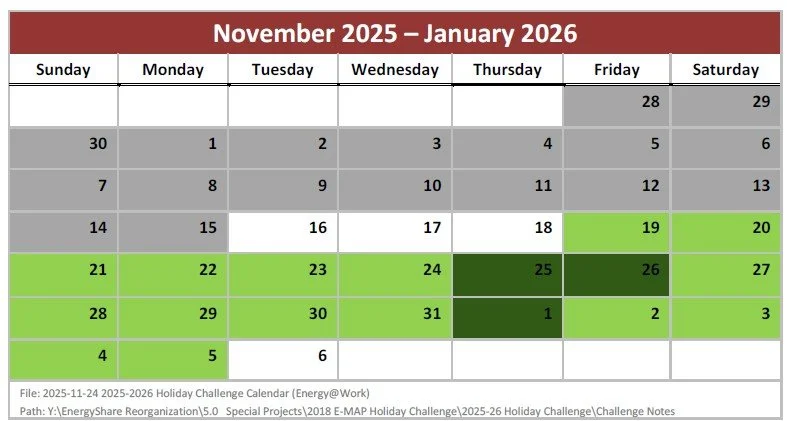
8th Annual Holiday Challenge: December 19, 2025 to January 5, 2026!

Energy@Work’s 8th annual holiday challenge is under way! The holiday challenge presents the opportunity to discover how much energy can be conserved over the holiday period when occupancy is typically at its lowest. With operations teams and tenants working together, buildings can significantly reduce unnecessary energy use and cut waste. See our tips below from the Energy@Work elf.

Common areas of opportunity include:

  • plug load or what is commonly called “Phantom Power”
    - this is a huge waste!

  • systems continuing to run when not needed,

  • lights, particularly accent and interior lobby lighting,

  • TV screens and monitors have off switches which are rarely used in lieu of standby mode,

  • exercise equipment “in the ready mode’ but sitting idle.

This year’s challenge will take place:
6:00 PM Friday, December 19th, 2025
to
6:00 AM Monday, January 5th, 2026

Questions can be directed to: HolidayChallenge@energy-efficiency.com

We’re looking forward to seeing what savings were achieved
- stay tuned for the January 2026 “News and Views” for results! 


Case Study: Berkeley Castle's E-MAP Success!

Title 1.png

Built in 1871 in downtown Toronto, historic site Berkeley Castle is a 148,614 square foot commercial office/retail asset, housing nearly 300 occupants. Having achieved NRCan 2019 and 2020 ENERGY STAR Building Certification, Berkeley Castle continues to strive for energy reductions and optimum operational performance.

Screenshot 2021-07-15 102806.png

Following an energy audit in 2016, Berkeley Castle implemented their Energy Management Action Plan (E-MAP) as part of their long-term Energy Efficiency Initiative to optimize building operations and performance.

Screenshot 2021-07-15 102105.png
Screenshot 2021-07-15 103700.png

1. Real-time monitoring was installed in 2016 to allow Berkeley to: “Manage what we measure”.

2. A Building Automation System (BAS) was installed.

3. Third-party BAS commissioning was completed in 2018.

4. The E-MAP brings together a framework to track, manage and sustain reductions through the 3 Ps of: People, Process, and Products:

Screenshot 2021-07-15 104525.png
Screenshot 2021-07-15 104748.png

7th Annual Holiday Challenge: December 20, 2024 to January 6, 2025!

Energy@Work’s 7th annual holiday challenge is under way! This challenge presents the opportunity to discover how much energy can be conserved over the holiday period. Operations and tenants can work together and save energy since offices typically have a much lower occupancy over the holidays, which presents the opportunity to cut waste, see help from our Energy@Work elf.

Common areas of opportunity include:

  • plug load or what is commonly called “Phantom Power”
    - this is a huge waste!

  • systems continuing to run when not needed,

  • lights, particularly accent and interior lobby lighting,

  • TV screens and monitors have off switches which are rarely used in lieu of standby mode,

  • exercise equipment “in the ready mode’ but sitting idle.

This year’s challenge will take place:
6:00 PM Friday, December 20th, 2024
to
6:00 AM Monday, January 6th, 2025

Questions can be directed to: HolidayChallenge@energy-efficiency.com

We’re looking forward to seeing what savings were achieved
- stay tuned for the January 2025 “News and Views” for results! 


Paris 2024 Olympics: Setting a New Standard for Sustainability

The Olympic Games have long been a symbol of global unity and athletic excellence, but their environmental impact, particularly in terms of CO2 emissions, often goes unnoticed. Host cities face the challenge of balancing the grandeur of the Games with the need for sustainability.

The article Olympics 2024: Going Green Instead of Gold published by BOMA BEST early this month gathers historic data from previous Games.
 

“The London 2012 Olympics generated an estimated 3.3 million tonnes of CO2, nearly equivalent to the annual emissions of a coal plant, with construction accounting for 50% and energy use for 25% (Gold and Gold, 2015). The Rio 2016 Olympics had a carbon footprint of about 3.6 million tonnes of CO2, equivalent to the annual emissions of roughly 800,000 people (Rowberg and Rincker, 2019). Of Rio’s emissions, 30-40% came from energy consumption at venues, and 25-30% was from transporting athletes, officials, and spectators (Trendafilova et al., 2017).”
 

The Paris 2024 Olympics organizing committee has established a new model for the Olympic and Paralympic Games, aimed at delivering a more responsible, sustainable, and inclusive event.

The Legacy and Sustainability Plan for the Paris 2024 Olympic Games initiatives include:

  1. Climate Action and Carbon Reduction: Paris 2024 aimed to be the first Olympic Games aligned with the Paris Agreement on climate change by using existing or temporary venues to minimize construction emissions, implementing renewable energy solutions, and offsetting unavoidable emissions through certified carbon offset projects to achieve carbon neutrality.

  2. Circular Economy and Waste Management: Paris 2024 focused on reducing waste and promoting a circular economy by minimizing single-use plastics, designing a comprehensive waste management plan, and repurposing materials from temporary facilities to create a more sustainable event.

  3. Biodiversity Preservation: The Games prioritized protecting and enhancing biodiversity through the restoration of green spaces, planting trees, creating urban forests, and ensuring all construction projects meet stringent environmental standards to safeguard local ecosystems.

  4. Sustainable Mobility: To reduce transportation-related emissions, Paris 2024 emphasizes sustainable transport options such as public transport, cycling, and walking.

  5. Legacy of Sustainable Innovation: Paris 2024 seeks to leave a lasting impact by showcasing sustainable innovations, supporting long-term urban development, and encouraging practices that will benefit host communities and set new standards for future events.

We hope this positive trend extends across industries. The significance of making meaningful changes is clear, and as the Paris 2024 Olympics have shown, achieving a substantial impact is entirely possible.


Vertical Solar Panels: A Groundbreaking Approach to Sustainable Building Design

In a groundbreaking move toward sustainability, a 1960s Downsview apartment building has turned a routine balcony upgrade into an opportunity to embrace renewable energy. Instead of conventional glass railings, the building’s owners installed solar panels that double as balcony railings. This initiative not only enhances the building's facade but also reflects a forward-thinking approach to energy efficiency.

The project involves specially designed solar panels manufactured locally in Etobicoke, marking a new era of building-integrated photovoltaics (BIPV). Unlike traditional solar panels that are typically confined to rooftops, BIPV panels can be seamlessly integrated into various parts of a building, including walls, cladding, and as in this case, balcony railings. The panels on this apartment building capture sunlight from multiple angles without needing to directly face the sun, making them a versatile solution in urban settings where rooftop space is limited.

This project exemplifies how mandatory upgrades—like replacing balcony railings every 20 years for safety reasons—can be leveraged to implement sustainable solutions. While the initial cost of installing solar panels was slightly higher than traditional materials, the long-term benefits in terms of energy savings and environmental impact make it a worthwhile investment. The solar panels come with a 25-year performance warranty, ensuring the investment pays for itself multiple times over.

With over 1,200 linear meters of BIPV installed on this building alone, the solar balcony railings are expected to produce approximately 100 megawatt-hours of power per year.

This initiative demonstrates how urban developments can be both practical and visionary. It exemplifies how innovative thinking and sustainable technology can transform aging structures into environmentally friendly assets that benefit both the planet and the bottom line.
Read more about it here.


Energy Efficiency: A Key Focus in Real Estate’s Evolving ESG Landscape

Energy efficiency will take center stage in the 2025 GRESB assessment, as the global benchmark for ESG performance in commercial real estate enhances its energy performance metrics. GRESB will introduce a new approach by assigning energy efficiency scores to individual assets within participants’ portfolios. The updated methodology highlights the importance of operational performance data, covering energy consumption, metering, renewable supply, and efficiency improvements. 

Energy@Work welcomes this focus on energy efficiency as a key component of ESG performance. We have long emphasized that energy efficiency should be prioritized before investing in costly equipment upgrades or audits. Measures such as optimized HVAC scheduling, turning off equipment when not in use, and ongoing monitoring can yield significant energy savings and reduce carbon footprints.

Our E-MAP (Energy Management Action Plan) service exemplifies this approach, as it encompasses operational performance as a core concept and continual monitoring ensure energy is not being wasted. We believe that highlighting energy efficiency within ESG frameworks is essential for driving real progress towards sustainability goals and look forward to seeing more companies adopt this approach.