
Ontario’s Largest Energy Procurement Launch: Overlooking the Cost-Effective Solution of Energy Efficiency

The Ontario government has launched its largest competitive energy procurement initiative to date, aiming to generate up to 5,000 megawatts (MW) of electricity to meet the rising demand from families and businesses.

This unprecedented action supports Ontario’s diverse energy mix, including nuclear, hydroelectric, renewables, natural gas, and biomass, and emphasizes community consent, agricultural protection, and economic opportunities for Indigenous and northern communities. Developers must secure municipal support for new projects, and the plan includes specific measures to protect agricultural lands while prioritizing projects that respect Indigenous territories and leverage Crown Lands. A technology-agnostic approach will ensure a broad range of energy resources, with a rapid procurement timeline designed to meet Ontario's growing energy needs.

However, while the plan addresses future energy generation, it raises an important question: where is energy efficiency in this strategy?

Energy efficiency often provides greater economic benefits compared to new energy generation but remains underemphasized. Prioritizing energy efficiency can offer substantial savings, job creation, and long-term financial benefits, positioning it as a compelling alternative to building new generation capacity. Here’s why energy efficiency should be at the forefront:

  1. Lower Cost per Kilowatt-Hour Saved vs. Generated
    Saving energy through efficiency measures costs significantly less—around $0.02 to $0.05 per kWh saved—compared to the $0.05 to $0.15 per kWh cost of generating new energy. Making energy efficiency a more cost-effective option, yet despite these, current Conservation and Demand Management (CDM) programs are ending this year with no new initiatives announced.

  2. Avoided Infrastructure Costs
    Energy Efficiency reduces overall demand, potentially avoiding the need for costly new infrastructure like power plants and transmission lines.

  3. Job Creation and Economic Stimulus
    Energy efficiency investments are labor-intensive, generating three times more jobs per dollar compared to traditional energy generation. This sector positively impacts trades, planners, engineers, and financial experts, creating a ripple effect that benefits consumers, the economy, and energy companies.

  4. Reduced Energy Bills for Consumers
    Energy Efficiency directly lowers energy bills, delivering long-term savings, especially in residential and commercial sectors. In contrast, new generation addresses demand but doesn’t reduce consumption, often resulting in higher rates for consumers.

  5. Economic Multiplier Effect
    Money saved through efficiency is often reinvested into the broader economy, stimulating growth across various sectors. In contrast, the higher costs associated with new generation can limit disposable income and, consequently, broader economic activity.

  6. Long-Term Financial Benefits
    Energy Efficiency investments pay for themselves many times over, offering continuous financial benefits and contributing to economic stability. Our own verified savings of 16,000,000 kWh with Toronto Hydro highlight the potential of ongoing efficiency improvements, particularly in the commercial sector amid increasing urban electrification.

Ontario’s ambitious energy procurement plan is a step towards securing the province’s energy future, but energy efficiency must be integrated into this strategy. By investing in efficiency measures alongside new generation, Ontario can achieve more cost-effective, job-creating, and consumer-friendly energy solutions, ultimately enhancing the economic and environmental resilience of the province.

Energy@Work’s Energy Management Action Plan (E-MAP) has proven to be a reliable roadmap for many. By optimizing building performance without compromising safety, comfort, or equipment reliability, E-MAP is helping to achieve a 30% economic potential!

For more information email: Requests@Energy-Efficiency.com


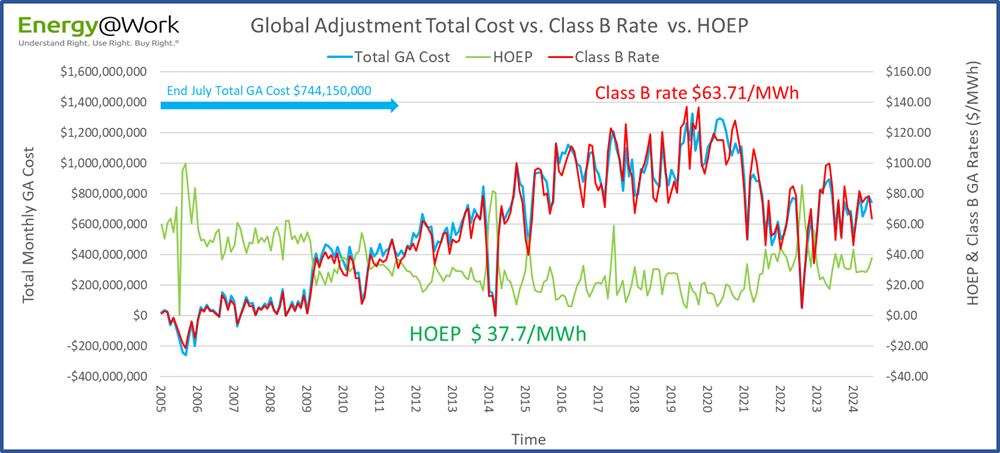
July’s Global Adjustment Mechanism (GAM)e Cost: $0.74 Billion

In July 2024, the GA cost was $0.744 billion, which is a 5% decrease from the June 2024 GA cost ($0.783 billion).
If we compare July 2024 with July 2023, there was a 33% increase (it was $ 0.561 billion).

The Class B July GA rate was $63.71/MWh ($0.064/kWh). The Average HOEP for July was $37.7/MWh ($0.038/kWh)

With these drastic monthly swings in cost, Energy@Work continues to ask “why?”. We provide a monthly review of GAM costs, however, the reason for the cost as well as the vast cost fluctuation remains unclear.

Energy@Work’s services include a “GAM coach”. We maintain the importance of a GAM Strategy for Class A and Class B in order to win the (GAM)e. Our collective savings have exceeded $10 million, and we look forward to continuing to assist.


Monthly Feature: Energy@Work to Present Key Insights at the 19th SDEWES Conference in Rome

Energy@Work is proud to announce its participation in the 19th Conference on Sustainable Development of Energy, Water and Environment Systems (SDEWES), taking place in Rome from September 8 to 12, 2024.

The SDEWES Conference is dedicated to advancing and sharing knowledge on methods, policies, and technologies that increase sustainability by decoupling growth from the use of natural resources and transitioning to a knowledge-based economy—all while considering the economic, environmental, and social pillars of sustainable development. The event will bring together researchers, industry leaders, and policymakers to discuss integrated solutions across energy, water, waste, transport, and other critical sectors. Learn more about the conference here.

Our Managing Partner, Scott Rouse, a seasoned expert in energy management, has been invited to present insights from Energy@Work's “28 Energy Management Action Plans that can lead the commercial sector’s path to Net Zero.” His presentation will highlight actionable strategies and lessons learned from these action plans, demonstrating how the commercial sector can effectively transition to Net Zero through integrated energy management and sustainability practices.

Canadian Bill C-59: Strengthening Regulations to Stop Greenwashing

In November 2023, the Canadian government introduced Bill C-59 as part of the Fall Economic Statement, aimed at preventing greenwashing regulations via the Competition Act. This bill passed without amendments on June 19, 2024, and received Royal Assent the following day.

Bill C-59 introduces key amendments to Section 74.01 of the Competition Act ( RSC , 1985, c. C-34) to address "greenwashing".

Canada is taking significant steps to ensure companies avoid greenwashing, referring to false, misleading, or deceptive environmental claims, and instead focus on transparency and making genuine commitments to environmental improvement.

The new regulations under Bill C-59 will significantly impact how companies’ market and promote their products and services. Instead of investing in wasteful PR practices, companies are encouraged to make smart investments to achieve economic benefits while reducing their environmental footprint. Greenwashing can severely damage a company's reputation and consumer trust, especially with the rapid spread of information via the internet and social media.

Claims of net zero, sustainability, and being a ‘green’ building will need to have the numbers and approved methodology to support those claims. The Efficiency Valuation Organization provides internationally accepted Measurement and Verification Plans to support project claims.

Municipalities are stepping up to help reduce greenwashing by mandating buildings to report their utility consumption using verified professionals. Benchmarking the true consumption of large buildings is the first step in understanding where improvements should be focused.

New York City’s local law-97 mandates that buildings over 25,000 SqFt report their Green House Gas (GHG) emissions using a qualified professional or face a harsh fine for not reporting.

Certain buildings are subject to annual greenhouse gas emissions limits established by Local Law 97 of 2019 (LL97). The first compliance reports for buildings covered by LL97 are due by May 1, 2025, and reflect emissions in calendar year 2024.

Toronto followed suit and now requires a Licensed Professional to report energy and water with the provision of a fine for not reporting. Discussions are underway for Emission Performance Standards.

Energy@Work has been a long-time advocate for eliminating greenwash. Our Energy Management Action Plan (E-MAP) is specifically tailored to review real consumption patterns to determine the best strategy for long term improvement. We are pleased to see this positive change in direction.

“If we are going to say it then let’s do it”


Canadian Electricity Advisory Council’s Final Report - Powering Canada: A Blueprint for Success

On June 10, 2024, the Canada Electricity Advisory Council publicly released its Final Report, Powering Canada: A Blueprint for Success. This report is a significant milestone in Canada’s journey towards a more sustainable and efficient energy future, as it outlines strategies for decarbonizing and expanding Canada's electricity grid.

As noted in the article Canada Electricity Advisory Council Recognizes the Demand Side by Efficiency Canada, the Council underscores in their report that enhancing energy efficiency and load flexibility is essential to mitigate the necessity for costly new electricity infrastructure. To achieve cost reductions in future electricity systems, the Council asserts that substantial improvements in energy efficiency and demand-side management (DSM) are essential strategies.

One of the four main priorities identified in the report is "Saving Energy to Lighten the Load," emphasizing the importance of reducing electricity consumption to lower overall system costs and enhance sustainability.
 

“The most sustainable form of energy is the kilowatt hour you don’t need to produce” - Efficiency Manitoba
 

The report also stresses the importance of achieving net-zero building codes, which would support electrification and energy savings. Enhanced building codes can reduce peak demands, improve grid reliability, and integrate renewable energy.

For more information read the full report by clicking the image below.


Ontario Regulation 506/18 Energy and Water Reporting and Benchmark (EWRB) 2024 Window Closed - However: City of Toronto By-Law 367 Extended Deadline to October 31st, 2024

This year’s Energy and Water Reporting and Benchmarking (EWRB) window ended on July 1st, 2024. This was the first year that the deadline was not extended to accept submissions beyond July 1st to comply with O. Reg. 506/18.

Energy@Work successfully completed over 200 submissions on behalf of buildings around the province to comply with the Ministry of Energy.

In addition, the City of Toronto requires properties to report per By-Law 367, and the reporting window was extended to October 31st, 2024.
 
Below is an example of the compliance certificate that was provided.

For those who still need to complete their submissions to comply and require assistance, click the button below for more information.


June’s Global Adjustment Mechanism (GAM)e Cost: $0.78 Billion

In June 2024, the GA cost was $0.783 billion, which is a 12% increase from the May 2024 GA cost ($0.700 billion).
If we compare June 2024 with June 2023, there was a 1% decrease (it was $ 0.788 billion).

The Class B June GA rate was $78.40/MWh ($0.078/kWh). The Average HOEP for June was $31.4/MWh ($0.031/kWh)

With these drastic monthly swings in cost, Energy@Work continues to ask “why?”. We provide a monthly review of GAM costs, however, the reason for the cost as well as the vast cost fluctuation remains unclear.

Energy@Work’s services include a “GAM coach”. We maintain the importance of a GAM Strategy for Class A and Class B in order to win the (GAM)e. Our collective savings have exceeded $10 million, and we look forward to continuing to assist.


Monthly Feature: Energy@Work has been recognized with the ENERGY STAR® 10th Anniversary One-Time Recognition Badge

Energy@Work is excited to share that Natural Resources Canada (NRCan) recognized our ENERGY STAR® for Buildings certification contribution!

NRCan celebrated the 10th anniversary of the Canadian adaptation of ENERGY STAR® Portfolio Manager® in 2023. In recognition, NRCan launched a special one-time ENERGY STAR 10th Anniversary One-Time Recognition Badge.
 
NRCan’s building certification program recognizes Canada's most energy efficient buildings through ENERGY STAR® Building Certification. This globally recognized label highlights Canadian buildings that have qualified in the top 25% of energy performance. An ENERGY STAR® Certified Building boasts lower operating costs, reduced energy consumption, decreased greenhouse gas emissions, increased asset value, and greater marketability.
 
We extend our gratitude to our valued customers for trusting us to complete these important submissions on your behalf. Your confidence in Energy@Work has been pivotal and we look forward to continuing our work together in creating a greener future.
 
Thank you to all our clients and partners for your unwavering support. We look forward to certifying even more buildings in 2024!